Copy Platform – Product
Copy Platform – Product
The third phase of the advertising concept focuses primarily on the product or service. The copy platform not only defines unique selling propositions (product benefits) and advertising benefits, but also the product positioning and the promise (slogan). In addition, this is where the decision is made on HOW the product or service will be advertised—that is, in what style (tone) and with what visual, textual, and auditory design elements.
Button: For assistance
USP (Unique Selling Proposition)
Why is the unique selling proposition so important?
The unique product benefit is meant to set the product apart from the competition; it is considered the most important prerequisite for sales success. What does my product offer MORE?
Once the USP is defined, the advertising benefits (UAP = Unique Advertising Proposition) are usually derived from it. In other words, the product benefit is specifically transformed into an advertising benefit.
This can also be a benefit that other products or brands have but do not emphasize.
Product Positioning
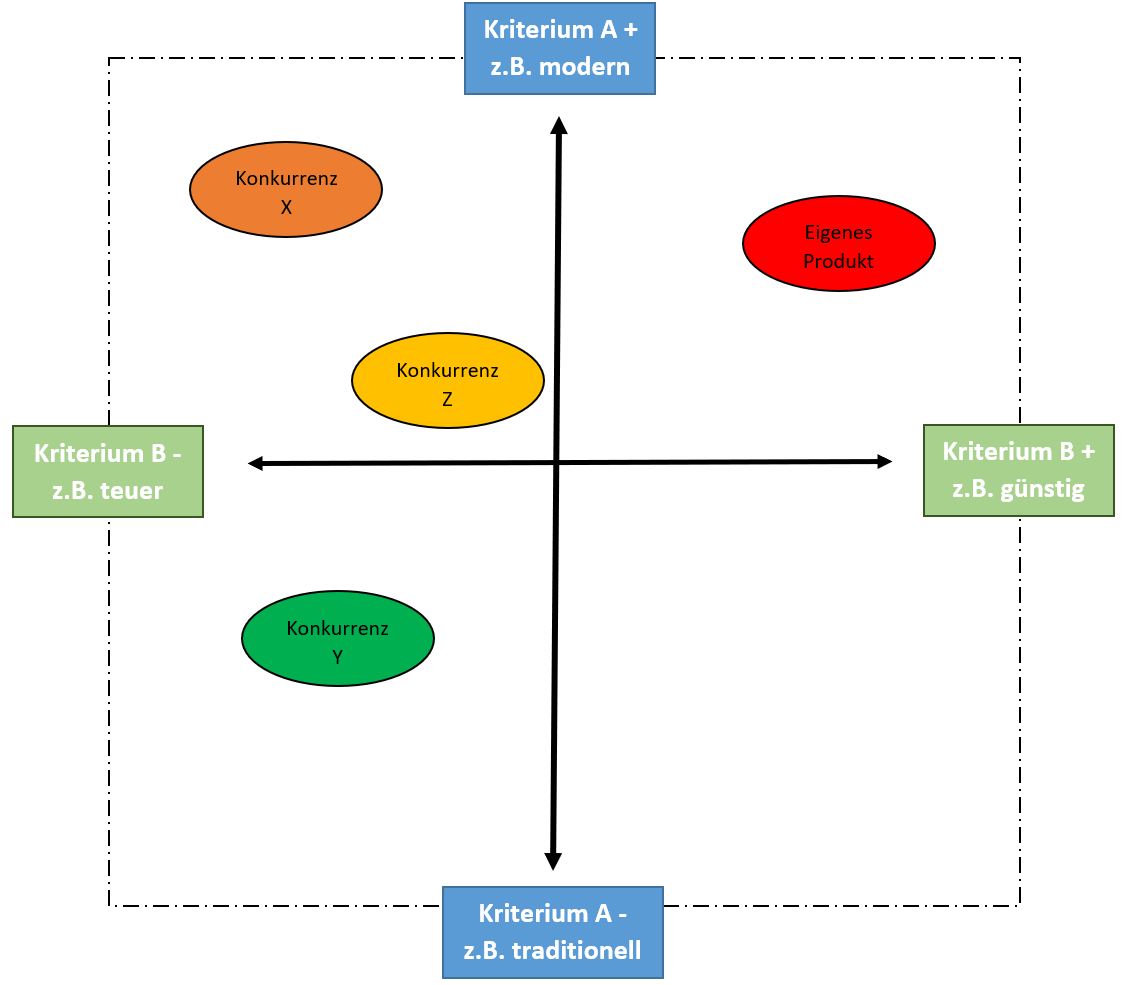
- The position of our product relative to the competition in the market
- Criteria that are important for positioning
- Are there any unique strengths?
- Distinctive product profile
A well-known tool is the positioning matrix. This tool is used to define the dimensions in which the product differentiates itself from and/or stands out against the competition. The most important thing is to select the criteria strategically and position them optimally. Typically, the 3–4 most relevant competitors are shown in comparison with your own product. Your own company/product is always positioned in the top right corner.
Product Promise
As is well known, brand recognition is crucial in advertising. A slogan can build trust and underscore the promise. A slogan can be a phrase, word, or jingle that is used repeatedly. This gives every new product something like a seal of quality.
And that brings us to the HOW.
Now it’s a matter of deciding what style the advertising campaign should have.
Advertising Style: The tone determines, for example, whether customers are addressed informally or formally, whether and how “cheeky” or “direct” the ad can be, and whether the campaign is “entertaining” or “informative.”
Visuals: Design, visual language, colors, images/video/animation
Text: Sales-driving words/phrases; text that reinforces the visual language. Here, the golden rule usually applies: “less is more!”
Audio: Any auditory elements supporting the campaign. Use of a jingle!
Guidance
To define your USP and UAP, position your product, and decide HOW the campaign should look, the following questions can help:
- What makes our product unique?
- What benefits does the customer get? Any added benefits?
- Why should the customer buy the product?
- What does the customer need to decide to buy the product?
- How does the customer want to be addressed?
- How do I draw the customer’s attention to the product?
A Product in the Spotlight